By Andrew Shugyo Daijo Bonnici, Ph.D. — Doctor of Applied Meditation Psychology
Click any part below to jump directly to it, or scroll through all four teachings in order. Each page builds on the last — together they form a complete education on stress, the nervous system, and the practice of AMT®.
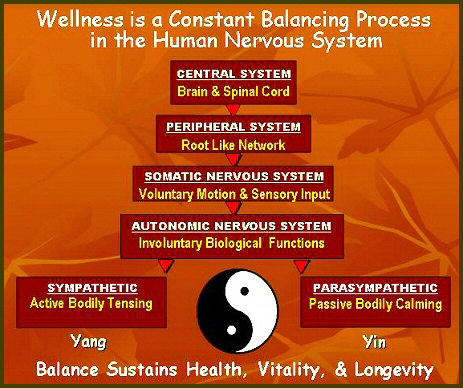
The human nervous system can be viewed as a pyramid. At the top of the pyramid is the central nervous system — the brain and spinal cord. The brain is the initiator and controller of our body movements. The spinal cord provides the brain access to incoming sensory information and nerve pathways through which the brain communicates with our various biological systems, organs, muscles, and skeletal structure.
The vast root-like network of neuron cells that leave and enter the spinal cord are called the peripheral nervous system. Information as nerve impulses reaches the spinal cord through neural pathways and is transmitted to the brain. After the brain processes the information, it sends signals that travel back down the spinal cord and leave as the peripheral nerve pathways to convey electrochemical messages to our biosystems, organs, and muscles.
At the middle of the pyramid is the somatic nervous system — certain peripheral nerve fibers that send messages to the central nervous system and nerve fibers that send messages to the skeletal muscles. This means the somatic system conveys sensations from our eyes, ears, nose, and other sensory organs to our brain, which processes the signals and then transmits nerve impulses to the skeletal muscles to permit voluntary control of our bodily movements. This dynamic sensory-motor process is largely within our conscious awareness.
Our body's automatic biological processes are controlled by the autonomic nervous system (ANS), which functions at the base of the pyramid and is the balancing point of the human nervous system as a whole. The nerves of the ANS convey sensory impulses from the blood vessels, the heart, and all of the organs in the chest, abdomen, and pelvis to parts of the brain. These autonomic messages often do not reach our consciousness, but elicit largely automatic reflex-like responses that send nerve signals to the heart, the vascular system, and all the organs of the body.
The autonomic nervous system consists of two opposing yet complementary systems: the sympathetic and the parasympathetic nervous systems.
During stressful conditions, the sympathetic nervous system quickens our heartbeat and breathing, and coordinates changes in blood flow to various bodily organs. It is part of our "fight or flight" mechanism — accompanied by the release of adrenaline (epinephrine) — which helps deliver a surge of power to our muscles in the face of immediate danger. The sympathetic system also temporarily inhibits digestion, immune system functioning, and tissue rejuvenation during stress.
The parasympathetic nervous system has the opposite effect — preparing our bodies for a more restful state. This system is dominant when we are not feeling threatened and are ready for relaxation. It conserves the body's energy resources, slows breathing and heart rate, decreases blood pressure, slows metabolism, and is key in the processes of relaxation and digestion.
The balanced operation and interplay between sympathetic and parasympathetic divisions of the ANS keeps your body working properly in all situations — sustaining the healthy functioning of your organs, immune system, cellular oxygenation, digestion, general metabolism, and tissue rejuvenation.
Constant reinforcement of the sympathetic side of your autonomic nervous system will disrupt the healthy functioning of your bodymind, make you more susceptible to illnesses, increase your vulnerability to genetic predispositions to specific diseases, shorten your lifespan, and detrimentally impact the quality and fullness of your daily life, work satisfaction, and interpersonal relationships.
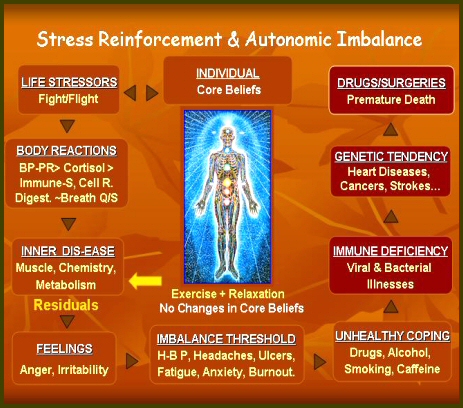
As noted in the diagram, most people use exercise and relaxation techniques as a way to counteract the daily negative psychobiological impact on their health and wellness. However, most people do not understand that the negative impact of stress is fundamentally a product of the relationship between stressing events and an individual's personality, perceptions, and core beliefs.
Daily exercise and relaxation techniques restore only a degree of balance and complementary functioning within the autonomic nervous system. This means that exercise and relaxation techniques continue to leave a degree of residual imbalance in autonomic nervous system functioning.
This residual autonomic imbalance has a tendency to build up over time due to the fact that there are no daily changes to the degree of reinforced stress reactivity at the level of personality, perception, attitudes, and core beliefs.
And as the residual autonomic imbalance continues to increase over time, the bodymind moves closer toward the crisis areas of the diagram — chronic illness, immune disorders, cardiovascular disease, and accelerated aging.
Exercise and relaxation help — but they do not reach the root. The fundamental source of chronic stress is the conditioned relationship between the ego's core beliefs, perceptions, and the stressful events of daily life. Without transformation at this deeper level, residual stress will always accumulate.
This is precisely where Applied Meditation Therapy® makes its most profound contribution — working directly with the personality, perceptions, and core beliefs that generate the stress cycle.
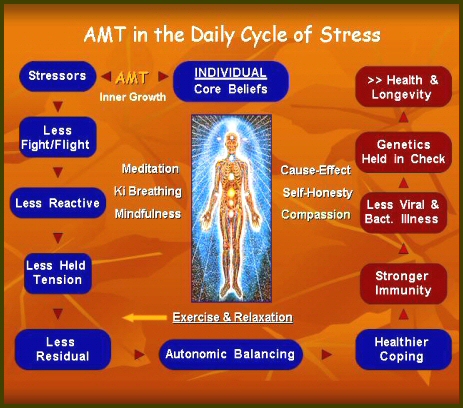
The diagram above shows how AMT® works on the daily refinement of personality, attitudes, core beliefs, and conditioned perceptions as they interact with stressful events.
Through therapeutic work with seated meditation, Ki breathing, mindfulness, self-compassion, engaged meditation, and a deeper understanding of the inner law of cause and effect, the individual develops insights into his or her personality dynamics and transforms behavioral stress reactivity into creative stress response-ability — the ability to respond to stressful conditions with a deeper somatic awareness, clarity, ease, creativity, insight, productivity, and proficiency.
Thus, in combination with an exercise program, the individual is empowered to:
Applied Meditation Therapy® is therefore a powerful way of practicing life's stressful conditions in order to simultaneously promote health, healing, wellness, longevity, personal growth, work productivity, interpersonal relations, spiritual integration, and character development.
Where exercise and relaxation work on the symptoms of stress, AMT® works on the source — the personality, perceptions, and core beliefs that determine how we relate to life's inevitable stressors. This is what makes AMT® not just a stress-reduction technique, but a complete path of health, healing, and human growth.
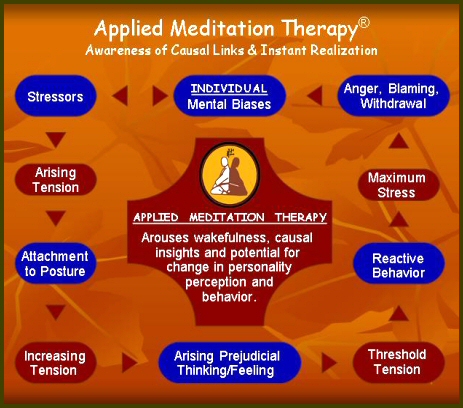
Dr. Bonnici identifies eleven sequential points in the stress-reactive causal chain — from the ego's core beliefs meeting a stressor, through reactive tension and defensiveness, all the way to maximum bodymind dysfunction and karmic reinforcement. This causal stress pattern can manifest in a matter of seconds, or unfold over several minutes.
The profound gift of Applied Meditation Therapy® is that it offers a conscious practice point at every step of this cycle. You do not need to catch the cycle at the beginning — even at point 9 or 10, the practice of AMT® can redirect the energy toward wisdoming and compassion.
In this Way, we can constantly promote our own physical wellness, healing, vitality, longevity, and inner growth, while simultaneously deepening and broadening our creative and joyful responsiveness to all our life activities and interpersonal relationships.
Whether you have a spiritual and religious life practice, or whether you approach life from a purely secular and scientific perspective, the teachings on this page apply equally. The autonomic nervous system does not discriminate — it responds to practice, to breath, to presence, and to compassion, regardless of belief.
Applied Meditation Therapy® is offered as a free educational resource for all people, of all faiths, in all walks of life.
Video counseling sessions available worldwide — Dr. Bonnici will help you apply AMT® to your unique life circumstances. No phone charges from anywhere in the world.